
Sport development in intellectual kids
Abacus Basic Fundamentals – Building Strong Minds Through Numbers
The Abacus is one of the oldest and most effective tools for learning mathematics. Used for centuries, it helps children develop not only calculation skills but also concentration, memory, and overall brain development. At the beginner’s level, learning the basic fundamentals of Abacus lays the foundation for speed, accuracy, and confidence in math.
What is an Abacus?
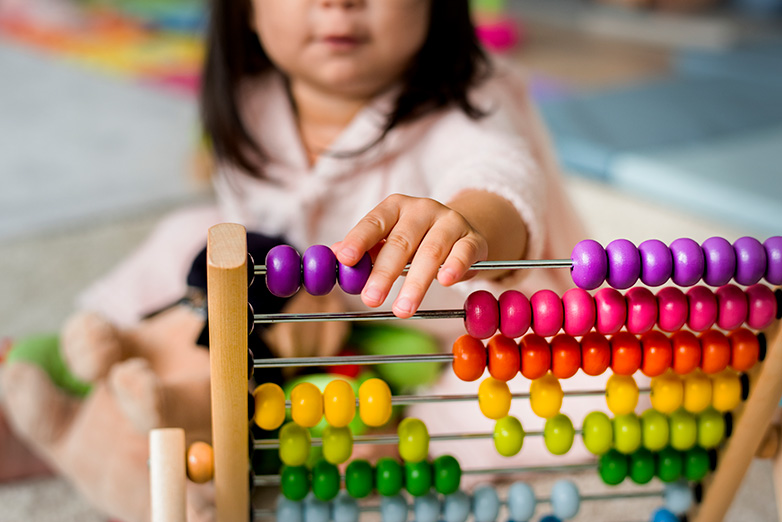
An Abacus is a simple counting tool made up of a wooden frame with rods and beads. Each bead represents a value, and by moving the beads, children learn how to perform arithmetic operations like addition, subtraction, multiplication, and division.
Basic Fundamentals of Abacus
- Understanding the Abacus Structure
- Each rod has beads divided into two parts: upper beads and lower beads.
- Upper beads represent the value of “5” each, while lower beads represent the value of “1” each.
- Place Value System
- Each column represents a place value – ones, tens, hundreds, thousands, etc.
- Moving beads on different rods helps children understand the place value concept deeply.
- Finger Technique
- Children are taught specific finger movements (usually thumb and index finger) to move beads.
- This builds hand-eye coordination and muscle memory.
- Basic Operations
- Simple addition and subtraction are introduced using the bead movements.
- Over time, children progress to multiplication and division.
- Visualization (Mental Abacus)
- Once children are familiar with bead movements, they are trained to visualize the abacus in their mind.
- This helps them perform mental calculations quickly and accurately without the physical tool.
Benefits of Learning Abacus Fundamentals
- Improves Concentration – Children focus deeply while moving beads and solving problems.
- Boosts Memory & Visualization – Mental math strengthens brain power.
- Develops Speed & Accuracy – Children solve problems faster than traditional methods.
- Enhances Confidence – Mastery of calculations builds self-belief in academics.
- Strengthens Foundation in Math – Concepts like place value, number sense, and arithmetic become second nature.
Why Start with Abacus at an Early Age?
The best age to start learning Abacus is between 4 to 14 years, as children’s brains are highly flexible and absorbent during this period. Starting early ensures that they build a strong mathematical foundation and develop life-long skills that go beyond numbers.